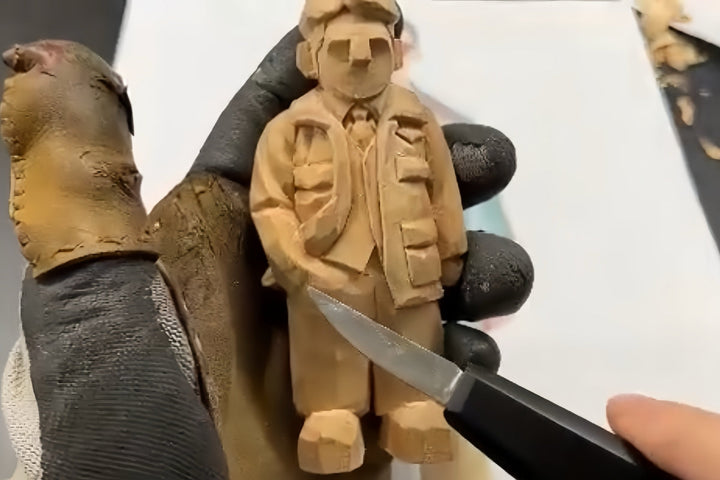
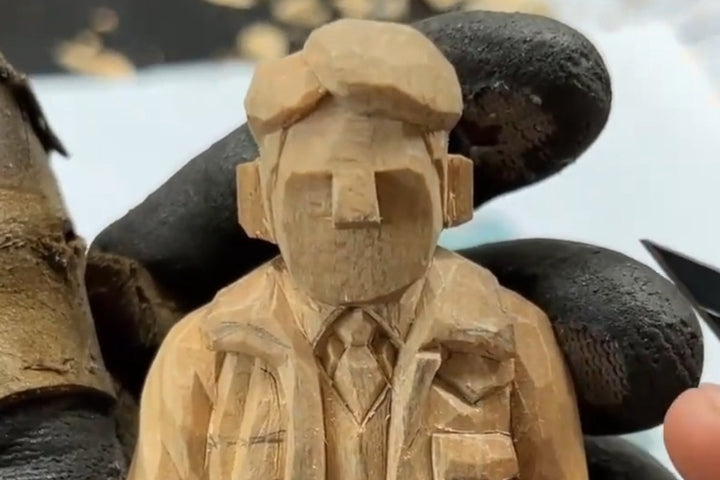
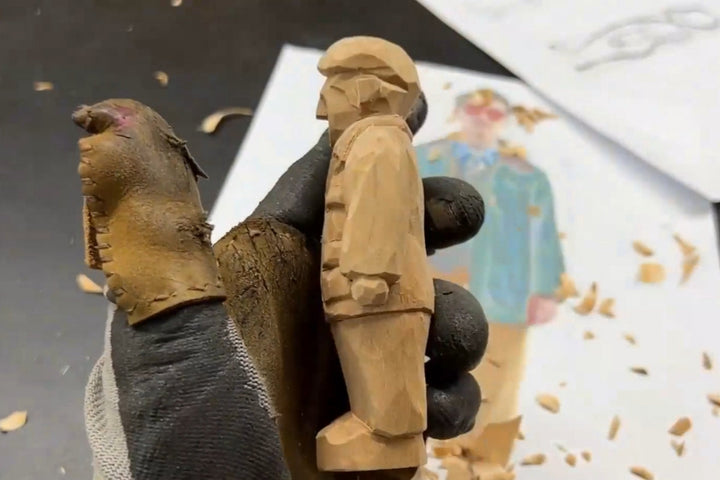
Wooden Gifts Carving: Detailing Clothes & Arms for Your Figurine
Hey everyone, this is Wooden Smile. In this post, we’ll show you how to handle the relationship between the clothing and the arms when carving wooden gifts. A lot of woodcarving beginners often ask: how do you create a sense of depth in your wooden gifts carving? And how do you decide exactly where to make your cuts? This tutorial covers everything you need to know.
If you’ve made it this far—congrats! Your figure’s overall shape is already in good form, and there shouldn’t be any major issues from here on out. Now let’s move on to refining a few more areas.
First, we’ll plan out the placement of the figure’s clothing and arms. Take a look at your reference photo and compare it with your wooden gifts project. For example, on the left side, the arm is posed with the hand in the pocket, which makes the relationship between the clothing and the arm a bit more complex.

Now, let’s break down just this one hand-in-pocket pose into five small sections:
1. The arm and the vest
2. The pants and the vest
3. The vest and the coat
4. The coat and the arm
5. The hand itself
All five of these parts meet at a single point—that’s the spot we’ve marked in the diagram, right?
First, we need to identify that point accurately. The next step is to figure out which part is closest to the viewer—whatever’s closest should be carved the highest, right?
In this example, the order from closest to farthest is:
1. Vest
2. Pants
3. Sleeve
4. Hand
5. Edge of the coat

Once we’ve figured out the front-to-back layering, let’s mark the wood accordingly. Start by using a pencil to sketch out that intersection point, then refine the lines for each section. Use thicker lines to draw out the shapes of the pants pocket, coat, vest, and sleeve.
You might notice some scratches left behind during earlier steps—don’t worry! You can fix that. Just stick to the lines you’ve drawn and carefully carve along them. One good slice here will help push the arm slightly inward. If you’re unsure, don’t cut too deep.

This process helps transform a rough wooden sculpture into something with more definition and life. Every subtle layer adds dimension to the overall look of the figure.
Next, use two passes with your carving knife to define the border between the coat and the vest. Do the same for the vest and the pants—mark that line with a carved groove as well.
Since we want the vest to appear higher than the other parts, the first cut is made at a steeper angle, and the second cut is more shallow. That creates a natural height difference between the layers.

Then extend that guide line downward. If you’re not very confident in your carving yet, feel free to make the line even more defined. This line represents the edge between the coat and the shirt underneath, coming down from the back of the neck. Make one cut to create a stop cut here. Since this part sits lower, your knife angle should also be more slanted.
Same idea as before: if you’re not totally sure about the lines, keep your cuts shallow. With patience, your wooden statue will gradually come to life.