Wooden Gifts Tutorial: How to Carve Legs and Feet for a Handcrafted Figurine
Hey everyone, this is Wooden Smile. In this post, we’re focusing on how to carve the legs and feet of your wooden figure. But before we jump in, let’s finish up the arm we started last time!
Let’s take a closer look at how a bent arm is structured. You’ve got the upper arm, the forearm, and the elbow in between. We’ll use a carving knife to mark a clear separation between the upper and lower arm so the shape is easier to define.

Now let’s make a few cuts to reveal the hand on this side of the figure. Once the hand is carved out, you’ll be able to tell how wide the arm should be—obviously, the arm can’t be as wide as the hand, right? So we’ll use the size of the hand as a guide to gradually reshape the arm.
In a natural, relaxed pose, the upper arm is mostly vertical while the forearm bends slightly. So we’ll draw in some guide lines and shave off a bit of wood from the back of the hand to reflect that bend.
Even though we’ve drawn the lines, we’re not cutting away all the wood just yet. Based on our experience making many wooden gifts, we know details like the shirt, collar, and pockets might affect the arm’s final position. So it’s better to leave a little extra material here, just in case we need to shift things later.

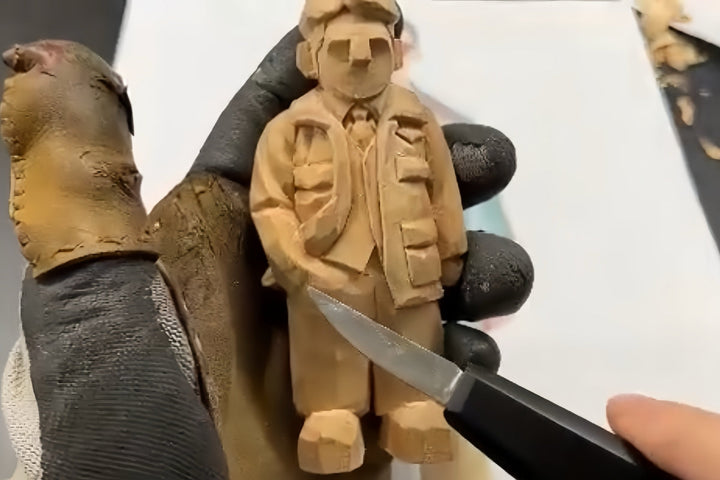
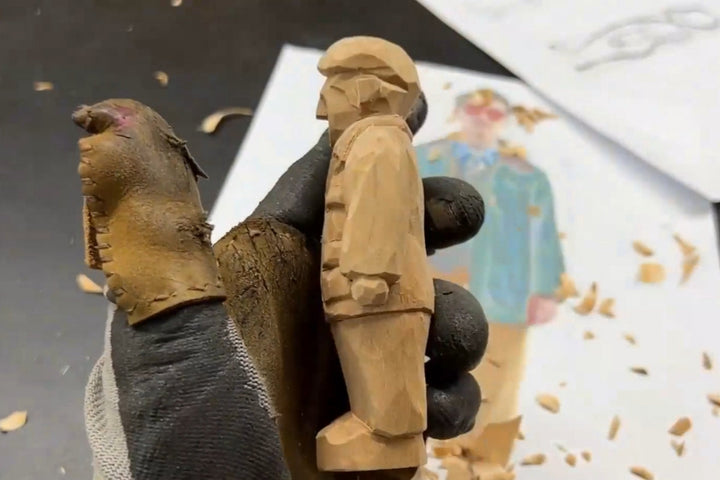
Now let’s move on to separating the feet from the legs. From the reference image, this wooden figure is wearing dress shoes and showing a bit of ankle. That means the bottom centimeter of the foot is definitely too thick—we’ll need to trim it down. As we do that, we’ll keep the natural upward slope of the foot, meaning the toe gets shorter while the top of the foot gradually rises.

Next, let’s mark the dividing line between the pants and the shoes. It’s okay for the pants to sit a little high, but keep in mind this figure is designed to have short legs—so if the pant line is too high, it’ll end up looking like shorts instead.

So within this limited space, we recommend exposing just a tiny bit of the ankle—or, for short-legged designs, you don’t have to show the ankle at all.
Naturally, ankles are thinner than pant legs, so we’ll taper the ankle downward.
Do the same on the other foot. Once that’s done, the line between the pants and the shoes becomes much more visible.

Of course, the feet still look a little oversized at this stage, but don’t worry. Let’s take a step back and look at the overall figure. You’ll see that the limbs, feet, and head have all taken on their basic forms.
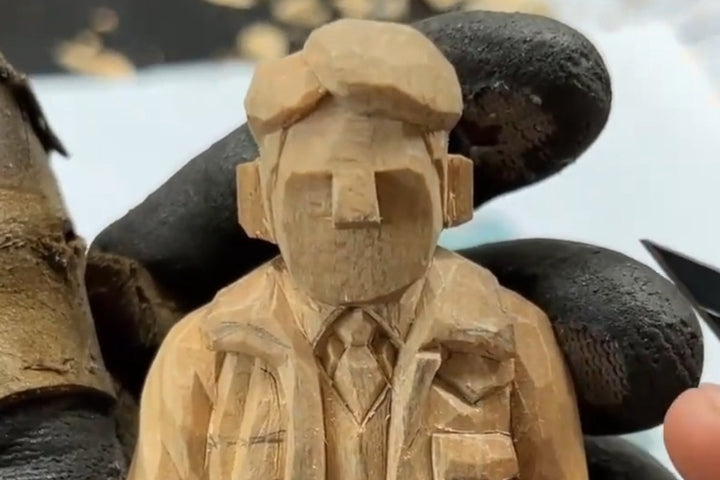
Once you’ve reached this stage, you can start working on the finer details—like the edges of the shirt, the pants, the shape and details of the shoes, and of course, the face and head. You can also begin slimming down the body little by little.

When carving wooden gifts, there isn’t always a sharp line between shaping the big forms and adding details. But you can treat the head, limbs, and each part as small milestones. For beginners, we recommend going through each of these steps with us.
At the beginning of your woodcarving journey, copying references is totally normal. And since we’re learning by copying, the goal should be resemblance—not perfection on the first try. If it doesn’t work out the first time, no big deal—you can always try again.
Thanks so much for following along with us. By now, we’ve completed an entire wooden figure from head to toe!