Wooden Gifts Tutorial: Carving Clothing Structure and Movement in Figurines
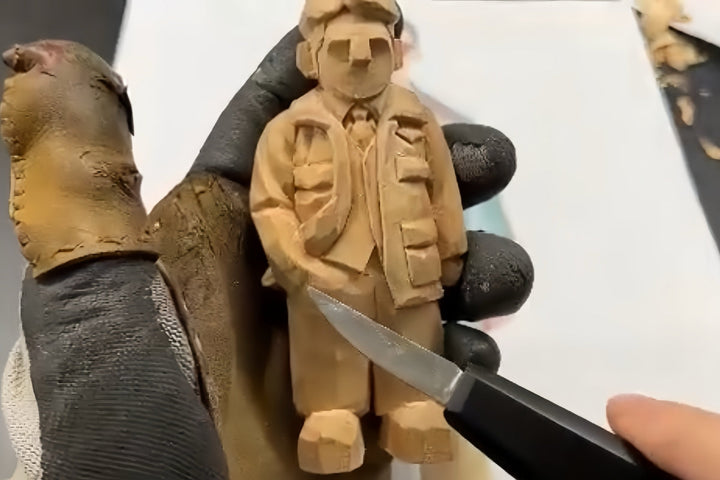
Hi everyone — this is Wooden Smile, your go‑to for handcrafted wooden gifts. In this tutorial, we’ll show you how to carve dynamic clothing folds that bring motion and realism to a wood figurine. With just a few careful cuts, you can make a carved character look alive.Let’s begin by examining the clothing edge of our figurine. The garment flips backward: Point 1 is closer to us, Point 2 farther. Because the figurine’s arm presses down on the fabric, the cloth needs to be tucked in carefully. The clothing should never look like it’s growing out of the arm — instead, we’ll clean up the transition where arm meets jacket so it looks natural and flowing.

One common mistake among beginner woodcarvers is this: they carve the basic structure for the body and clothes, but stop there. For example, garments and limbs may appear as separate parts, but if the direction and flow are not defined, the piece will look flat. That’s why sometimes one extra cut — done at the right angle — makes all the difference, showing how the wood carved cloth drapes and curves, adding depth and clarity to your piece.
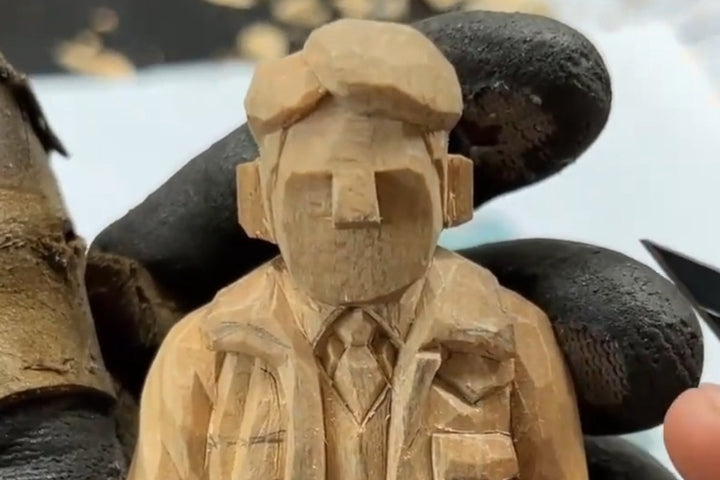
Going back to our figurine: the vest under the jacket needs to appear tucked in. To achieve that effect, we carve at a sharper angle and make a strong stop-cut. This simple trick makes the vest seem naturally embedded under the coat — a subtle but key detail in wood sculpture.

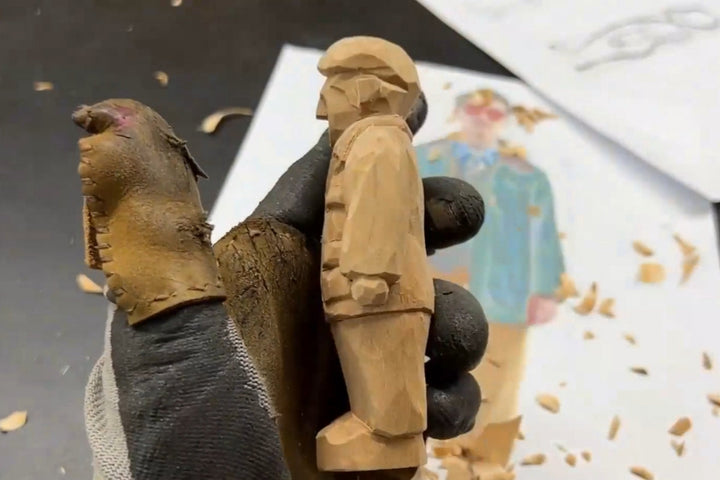
Next, observe the sleeve seam from the side in the reference image: it tilts slightly upward toward the neck, as if the fabric is pulled by the arm and dragged down by gravity. The folds we carve should reflect that motion. At the point where the cloth flips over — as marked in the image — that edge must not be a sharp distortion; instead we smooth it into a gentle curve, mimicking how real fabric behaves.

Now rotate the figurine to its side and inspect the back. The jacket’s zipper or seam line must continue smoothly onto the back. And because of gravity, the seam shouldn’t remain a straight vertical line — let it slope slightly downward as it wraps around. This attention to realistic flow enhances the quality of your wooden figurine.

Also, remember: clothes don’t cling flat to pants in real life. There’s usually a bit of space — a subtle “floating” effect. You don’t have to exaggerate it, but a small angle makes a big visual difference. Once you’ve carved it, check from the side that the fabric in front of and behind the arm align along the same diagonal — this ensures consistency and keeps your figure from looking distorted.

By following these careful steps — marking reference points, cutting at proper angles, layering garments with realistic depth, and respecting natural gravity — you turn a simple block of wood into a believable, well‑proportioned wood carving. That’s the heart of creating beautiful wooden gifts.